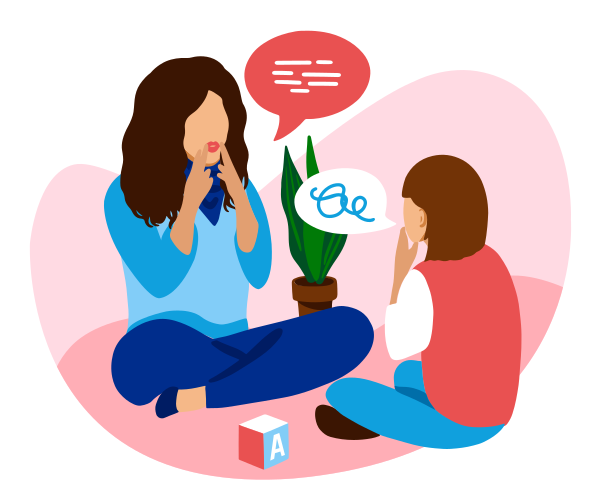
If you are having problems with your mental health and wondering where to turn to get help, if you are in the UK, it is often possible to get talking therapy/counselling without going through your GP. Below, the self-referral procedure for NHS talking therapy/counselling will be explored.
This may help you in taking your first steps in accessing help.
The procedure for self-referral usually involves an NHS talking therapy/counselling service, also known as an IAPT (Improving Access to Psychological Therapies) service.
These services are aimed at people experiencing more common problems such as depression, anxiety disorders, stress or panic attacks and the self-referral procedure is designed to allow easier access to these services without the necessity of a referral from your GP.
The first step to getting self-referred onto talking therapy/counselling is to find the service within your locality.
Typically this can be achieved by searching for “NHS talking therapies” online along with the name of your town or city.
Once you have located the appropriate service it is normally done either via the completion of a short online referral form, or via the telephone by calling the assessment line of the service.
On these referral forms you are generally required to give an outline of the way that you are feeling, when this started, how long it has been a problem for, and the effects it is having on your life.
Waiting Times After Submission
Once your self-referral is submitted you will be offered an initial assessment, likely by phone or video link.
Here a trained professional will explore aspects of your mental health further, assess your circumstances and consider what kind of help you are looking for.
It may then be recommended that you attend a session of guided self-help, join a group therapy session or attend one-to-one sessions in the form of Cognitive Behavioural Therapy (CBT).
Although NHS counselling services are readily available and extremely beneficial, the length of waiting lists should also be noted.
There can often be quite long delays between starting therapy and the commencement of a programme, and it may not be unusual for there to be several weeks, even months, between your assessment and the beginning of regular therapy sessions.
This can feel disheartening if you are seeking immediate assistance.
Due to these waiting times, some people opt to make private arrangements alongside NHS referral, as the availability for private therapy is far more immediate, and at times more adaptable.
In many cases such as online delivered CBT therapy it can be delivered at your convenience, from the comfort of your home; services such as Clearmind CBT offer online sessions where you can get to work addressing your mental health without the considerable waiting time of NHS therapy.
How Online CBT Works
Online CBT is particularly beneficial if you are suffering with anxious feelings, negative thought patterns or low mood.
Online CBT will focus on finding out unhelpful thinking habits and help you to find ways in which you can counter these thoughts.
A lot of people find CBT a very useful form of therapy that you can benefit from in a short space of time due to the fact that it is structured, as well as having clear goals.
It should also be taken in to account that self referring to the NHS is in no way preventing you from seeking private support at the same time as your NHS support.
Some people prefer to remain on the NHS waiting list whilst using private therapy, so that you have the best of both options. This may mean that you will get instant support whilst you have a longer term plan to rely on.
In conclusion, self referring to the NHS for counselling is a straightforward process that will grant you access to appropriate mental health support, but you need to bear in mind that demand is high, and so you may have a longer waiting time than most.
Finding alternative means to support yourself, such as Online CBT via sites like ClearMind CBT will aid you in accessing mental health support more readily. The crucial first step, either NHS or private, will help improve your mental well being.